
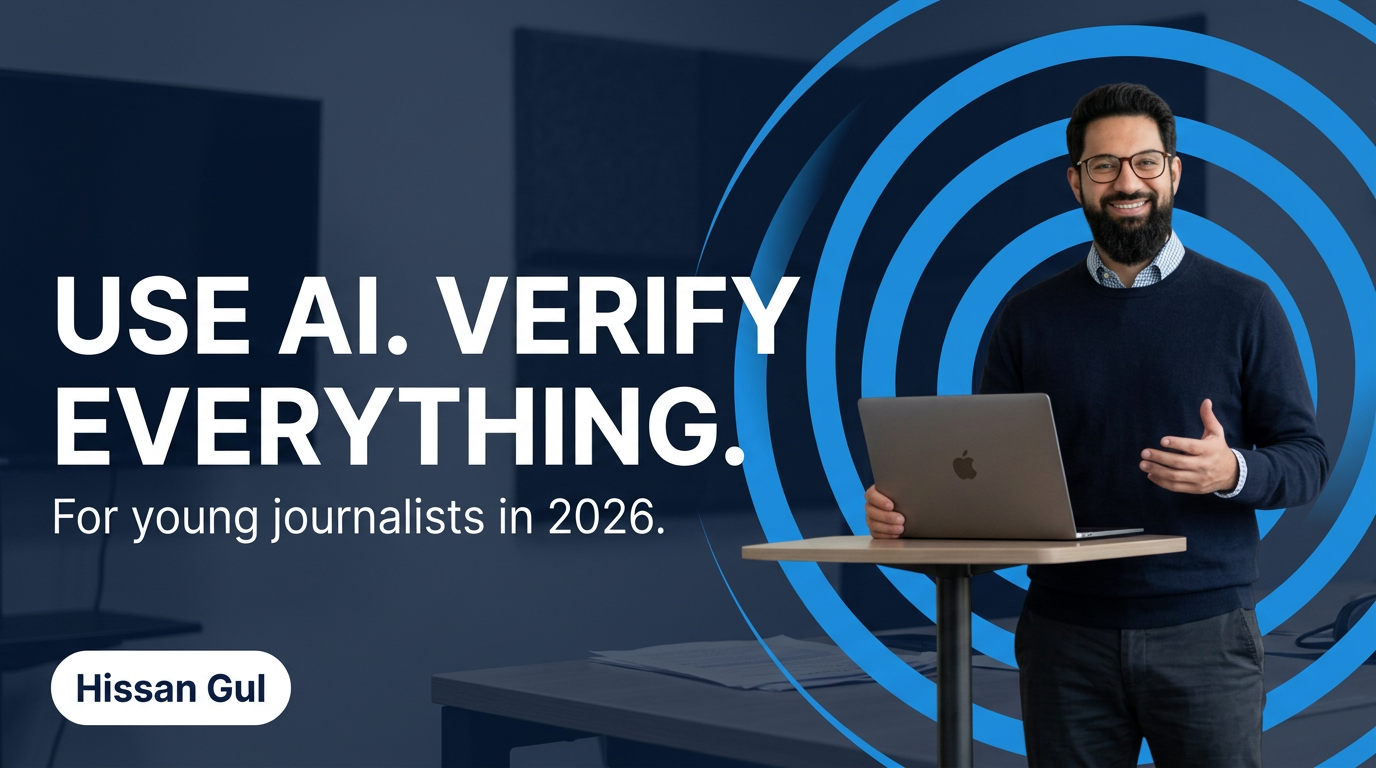
Every young journalist I meet is asking one of two questions about AI, and they are both the wrong question. The first is “will it take my job?” The second is “is using it cheating?” Here is a better one: what does a journalist who uses these tools honestly actually do differently from one who doesn’t? Because that person already exists, they are often junior, and they are quietly becoming twice as useful as the reporter sitting beside them. The short answer to how you should approach AI is this — use it to clear the friction around the work, keep the judgment and the reporting human, and never, ever publish anything it produced that you have not checked yourself.
Let me settle the “whether” question with a number, because it is already settled in practice. In Muck Rack’s State of Journalism 2026, drawn from nearly 900 working journalists surveyed in March, 82% said they already use AI tools regularly — ChatGPT most of all, then Gemini. That is not a handful of reporters at tech startups. That is beat reporters, editors at regional papers, foreign correspondents. AI has become as ordinary in a newsroom as a press credential. So the useful conversation is no longer whether. It is how — and how is where careers are made or quietly ended.
The right mental model
Think of these tools as a very fast, very confident intern who has read almost everything and verified none of it. Handled that way, an intern like that is a genuine gift. Trusted blindly, that same intern will hand you a fabricated quote with a straight face and end your credibility with it. Everything that follows comes down to holding that picture in your head: enormous help, zero accountability. The accountability stays yours.
Where AI genuinely helps
Used well, these tools take the drudgery out of the parts of journalism that never made your work better anyway. Transcribing a two-hour interview so you can spend your time on the follow-up instead of the typing. Getting the gist of a fifty-page report before you decide whether it deserves a close read. Translating a source’s words so you can move faster across languages. Turning a messy pile of notes into a first structure that you then rewrite entirely in your own voice. Sifting a spreadsheet for the one outlier worth a phone call. None of that is the story. All of it is the friction around the story — and clearing friction is exactly how a young reporter buys back the hours that real reporting demands.
I am deliberately not handing you a ranked list of tools and settings, and there is a reason. The specific products change every few months; the skill does not. The skill is knowing which task to hand off, how to ask for it so the output is actually useful, and — this is the whole game — how to check what comes back. That judgment is the thing that separates a journalist using AI from a journalist being used by it, and it is the part worth learning properly.
The lines you do not cross
This section matters more than any tool, so read it twice. You never publish anything an AI produced that you have not independently verified — these systems invent facts, quotes, and sources with total confidence, and “the AI said so” has already ended careers. You never feed a confidential source’s identity, or unpublished sensitive material, into a tool you do not control; you do not know where that data goes. You are honest — with yourself, your editor, and where it matters your audience — about what the machine touched. And the reporting itself stays yours: the being there, the asking, the human on the other end of the phone. A tool can help you write. It cannot do journalism, because journalism is a relationship with the truth and with the people in your story, and you cannot outsource a relationship.
Why this is a Pakistani opportunity, not a threat
Our newsrooms are stretched thin — small teams, tight budgets, more to cover than there are hands to cover it. That is precisely the environment where a journalist who has learned to use these tools responsibly becomes indispensable, producing more and faster without lowering the standard. So the reporter who refuses to learn will not be replaced by a robot. They will be quietly out-produced by a peer who did learn, and who still checks everything. That is the real threat, and it is entirely avoidable.
There is a second-order point worth noticing. As audiences increasingly get their news through AI answers, trust in that news is low — surveys put trust in news delivered through AI answers far below trust in news overall. That gap is an opportunity for a human journalist with a name, a method, and a record of being right. The machine can summarise. It cannot be trusted the way a known reporter can. Lean into what it can’t do.
How to actually learn this
Don’t fear these tools and don’t worship them. Learn to supervise them. Give the intern the boring task, then check its homework as if your byline depends on it, because it does. Build the habit of asking, every time, “how would I defend this if an editor challenged it?” If the honest answer is “the AI told me,” you are not finished.
The honest part
I have spent the last two years building AI into how I research, verify, and produce — and the thirteen years before that learning why the fundamentals underneath it can never be outsourced. I now mentor newly graduated journalists in exactly this: using AI to work faster while holding the ethical lines that keep their name, and their outlet, credible.
So if you are starting out, the move is simple and it starts today: pick one tedious task this week, hand it to the tool, and then verify the result harder than you think you need to. And if you are a university, a newsroom, or an NGO training the next generation of reporters, this is the session everyone is asking for right now — because “should we use AI” is settled, and the real question, how do we use it without losing our credibility, is something you teach carefully, with someone who has already made the mistakes.
Key takeaways
- The debate is over: 82% of journalists already use AI regularly (Muck Rack, 2026). The question is how, not whether.
- Treat AI like a fast, confident intern that verified nothing — huge help, zero accountability; the accountability stays yours.
- Use it for the friction (transcription, gists, translation, first structure, data sifting), never for the reporting or the final word.
- Never publish unverified AI output, never feed it confidential source material, and be honest about what it touched.
- In lean Pakistani newsrooms, the responsible AI-using journalist is indispensable — the risk isn’t a robot, it’s a better-equipped peer.
About the author
About the author. Hissan Gul is a Pakistan-based digital strategist, audience analyst, and strategic communications expert with 15+ years across newsrooms, the development sector, e-commerce, and training. A Google-certified trainer and an International Center for Journalists (ICFJ) fellow and master trainer, he consults and trains on audience analysis, ethical OSINT methodology, digital communication strategy, AI in journalism, and mobile journalism — with hands-on experience building workflow automation for newsrooms, public relations teams, and not-for-profit organisations. He writes at hissangul.com.