
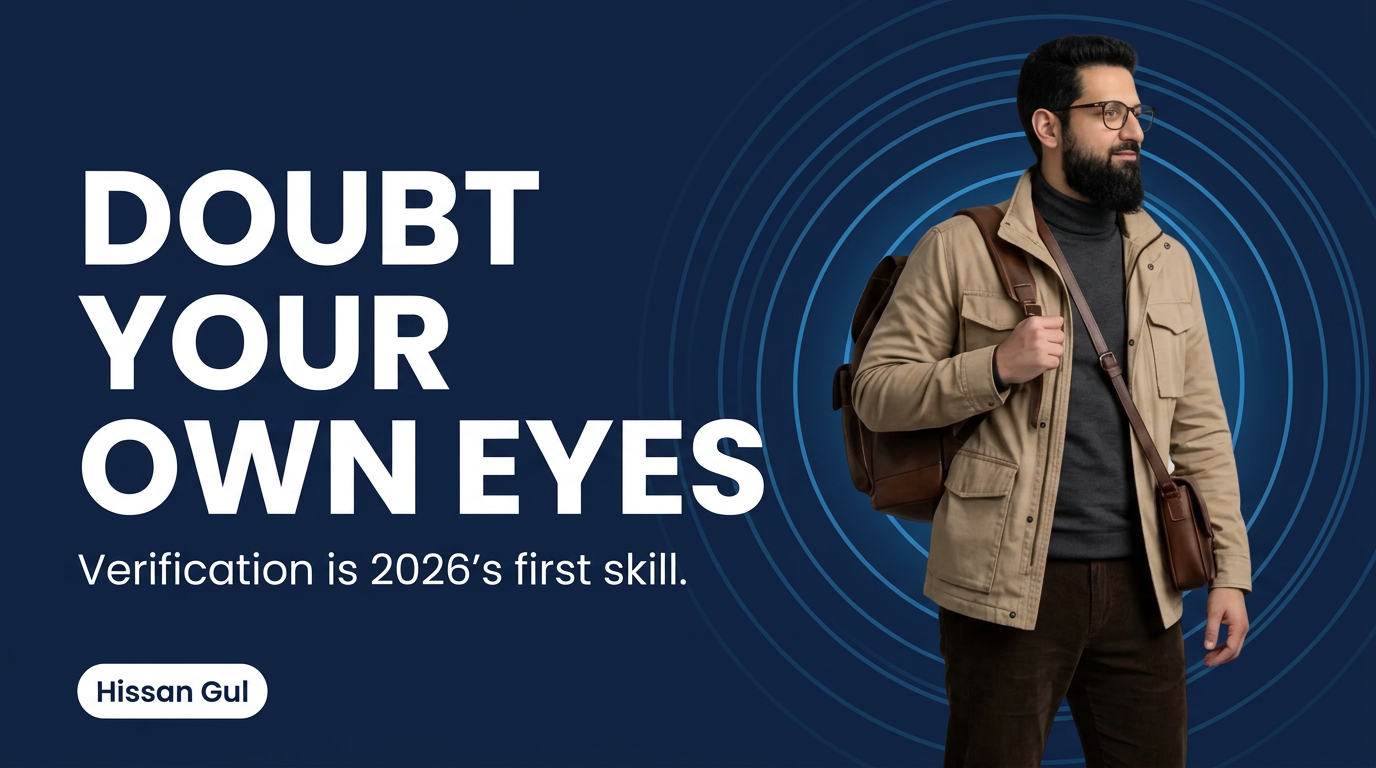
A photograph used to be evidence. A video was close to proof. That era is over. In 2026, a convincing image of a flood, a public figure, or a protest can be generated in seconds by someone with no skill and no budget, and it will land in a WhatsApp group in your city before any newsroom has seen it. For a young journalist, this rewrites the job description. The reporter’s oldest instinct — to doubt, to check, to ask “how do I actually know this is true?” — has quietly become the single most valuable skill you can offer an employer. Learn to verify, and you are useful anywhere. Skip it, and one wrong share can end your credibility before your career starts.
Let me put the shift in plain numbers, because the scale is easy to underestimate. The cybersecurity firm DeepStrike estimates the volume of deepfakes online jumped from roughly 500,000 in 2023 to around 8 million in 2025 — close to 900% growth a year, as reported by Fortune in late 2025. The tools that make them are now free, fast, and require no expertise: describe an idea, let a chatbot write the script, and generate polished audio and video in minutes. The barrier to manufacturing a convincing lie has essentially dropped to zero. The barrier to catching one has not.
Why “trust your eyes” is now a liability
Here is the uncomfortable research. When ordinary people are shown a mix of real and AI-generated media and asked to sort them, they perform at roughly the level of a coin flip. A 2026 Veriff study run with Kantar found that American respondents’ ability to spot fakes was statistically indistinguishable from random guessing. Read that again as a journalist: your untrained eye is not evidence. It never fully was, but now it’s actively dangerous, because the fakes have gotten better while our confidence has stayed the same.
The audience has shifted too, and in a way that cuts both directions. People have stopped assuming things are real and started assuming things might be fake. So a genuine photo now gets dismissed as “AI,” and a fabricated one gets shared as fact. In that fog, the journalist’s value is no longer just finding information. It is being the person who can say, with evidence, this one is real, and here is why — and this one is not, and here is how I know.
Verification is a workflow, not a hunch
The good news for a student with no money is that most verification costs nothing but discipline and time. When an image lands, you can establish where and when it first appeared — the “breaking” photo often turns out to be years old, from another country entirely. You can weigh what the picture claims against what is actually in it: the signage, the weather, the shadows, the script on a shopfront. You can trace a claim back to its earliest source rather than its loudest one. You can hold a suspicious video to a simple standard — who filmed it, where, and does anything in it contradict what we already know to be true.
I’m describing categories of thinking on purpose, not handing you a numbered checklist, and that choice matters. Verification done mechanically from a checklist is exactly how good journalists get fooled, because the people manufacturing fakes have read the same checklists you have, and they build their fakes to pass them. Real verification is a way of thinking that adapts to each case — part method, part hard-won suspicion. It is built through repetition on real, messy stories, ideally alongside someone who has been fooled before and learned from it. Nobody develops it from a single article, including this one.
Why this hits Pakistan hardest
In our information environment, misinformation does not wait for a fact-check. It moves through Facebook, YouTube comments, and family WhatsApp groups in Urdu and Roman Urdu, carried by trust between people rather than by evidence. By the time a careful correction is written and published, the fake has already done its work and moved on. That speed, in those languages, is the specific challenge here — and it is also the opportunity. A young journalist trained to verify quickly, in the languages the fakes actually travel in, is not a luxury for a Pakistani newsroom. In this environment, that reporter is the difference between an outlet people trust and one that gets publicly embarrassed on a slow news day.
The habit that protects you — and your newsroom
If you take one thing from this, make it a reflex: ask one more question before you share. Not before you publish — before you share, even privately, even in the newsroom group. That single pause, repeated until it’s automatic, is the foundation everything else is built on. The reporters who will thrive in this decade are not the ones with the fastest thumbs. They are the ones an editor trusts to be right when everyone else is rushing to be first.
The honest part
I have spent thirteen years learning to be usefully suspicious — first in television current-affairs newsrooms, where a wrong fact on air was a catastrophe you did not survive twice, and later across digital operations where I had to build verification into how a team of dozens of journalists worked every day. I learned some of it in formal training. I learned more of it the hard way, by being wrong and paying for it. What I can promise you is that it is teachable, and that it is best taught with real, ugly examples rather than clean theory.
That is the work I do now with young journalists: turning “I have a feeling this is fake” into “I can prove it, and here is my method.” If you are starting out, build the one-more-question habit today; it is free and it is everything. And if you are a journalism department, a newsroom, or an NGO training reporters and fact-checkers, this is one of the most in-demand sessions I run right now — because in 2026, a newsroom that cannot verify cannot be trusted, and trust is the only thing any of us are really selling.
Key takeaways
- Photos and video are no longer proof; deepfakes online grew from ~500,000 in 2023 to ~8 million in 2025 (DeepStrike, via Fortune).
- Untrained human detection is barely better than a coin flip (Veriff/Kantar, 2026), so “trust your eyes” is now a liability.
- Verification is an adaptive way of thinking, not a checklist — checklists are what fakers build their fakes to beat.
- In Pakistan, misinformation travels fast through WhatsApp and Facebook in Urdu and Roman Urdu; verifying quickly in those languages is a rare, valuable skill.
- Build one reflex first: ask one more question before you share.
About the author
Hissan Gul has spent 13+ years across Pakistani newsrooms and digital operations — as a senior current-affairs producer and as Head of Digital for Independent Urdu, coordinating 80+ journalists across 10+ countries. He has trained universities, institutions, and media teams in open-source research and digital verification since 2017, and currently mentors newly graduated journalists in verification and AI-assisted content production. He writes at hissangul.com and works with institutes, NGOs, and young journalists who want to build these skills properly.