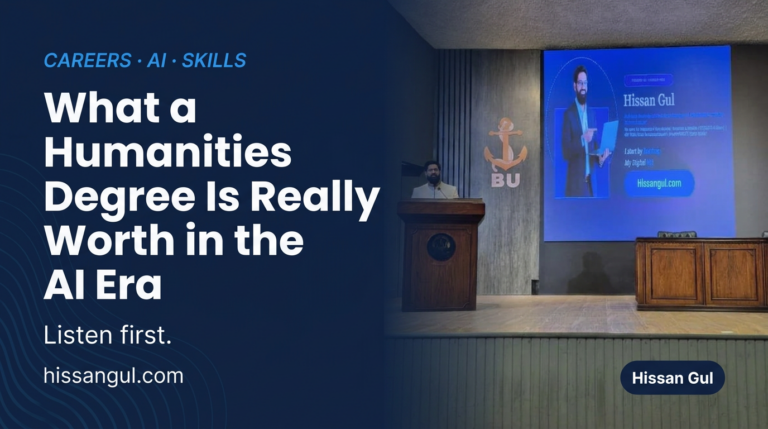
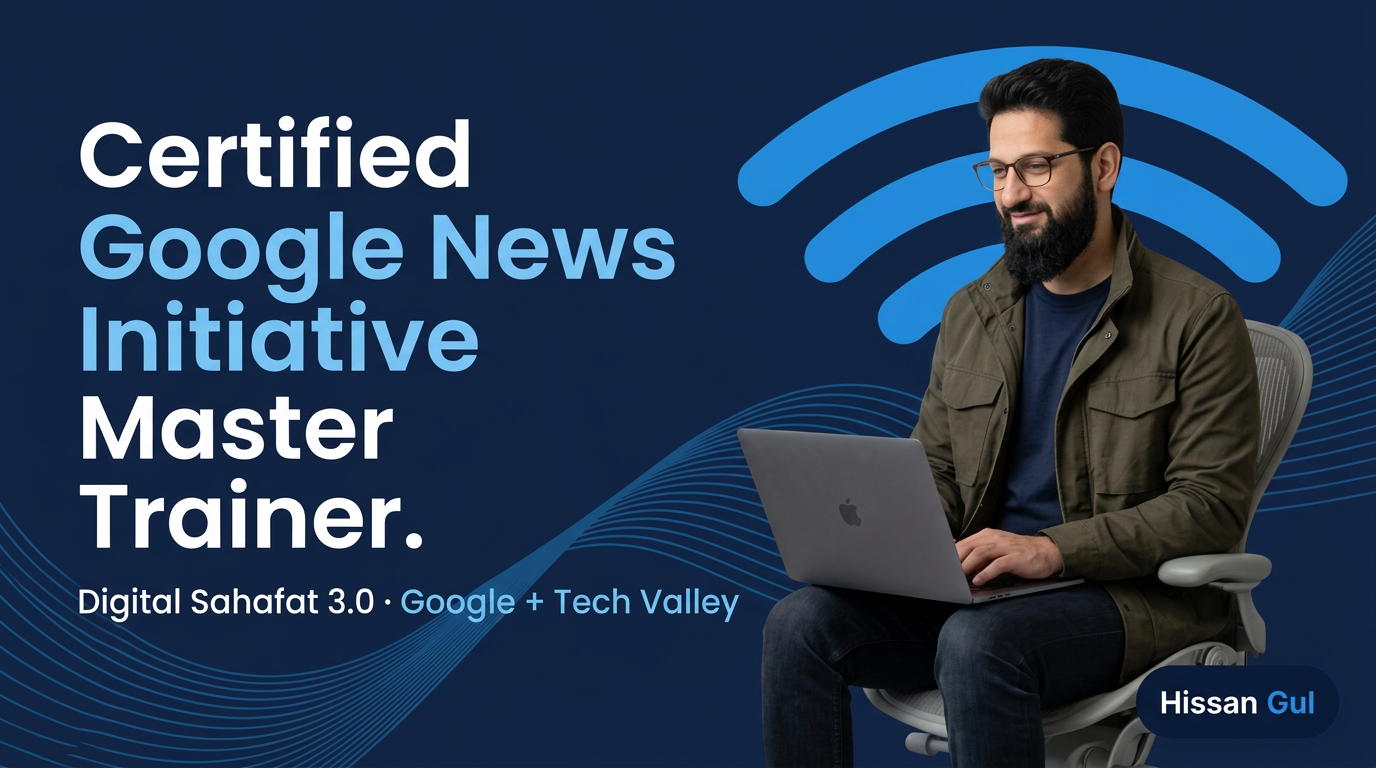
AI will not replace newsrooms, PR teams, or communications departments. But the ones who learn to direct it will quietly outpace the ones who don’t. I’ve just completed an intensive two-day Train-the-Trainers programme under Digital Sahafat 3.0 — the Google News Initiative programme delivered in Pakistan by Tech Valley, Google’s official local partner — certified to train others in exactly these tools. Here is what the training actually covered, and why it matters as much to public-relations and strategic-communications practitioners as it does to journalists.
Key takeaways
- Digital Sahafat 3.0 is a Google News Initiative programme run with Tech Valley; its Train-the-Trainers phase certifies master trainers to go on and train others across Pakistan.
- The two days went deep on three practical capabilities: automating repetitive workflows, building dashboards that turn scattered activity into strategic data, and producing cross-format content from a single story.
- The full toolkit covered the Gemini suite end to end, NotebookLM for source-grounded research, and Google AI Studio for designing and testing custom AI workflows — not just the chatbot, but the machinery behind it.
- The single most important shift: AI’s value isn’t in generating content — it’s in removing the manual work that stops teams from doing their real thinking.
- This is no longer a journalism-only skillset. PR and strategic-communications teams face the same pressures — more channels, less time, higher scrutiny — and benefit from the same tools.
What Digital Sahafat 3.0 actually is
Digital Sahafat is part of the Google News Initiative, Google’s global programme for strengthening the news ecosystem, and it runs in Pakistan through Tech Valley, Google’s official partner here. It works in phases: a first, intensive phase trains a cohort of master trainers directly, and those trainers then carry the skills outward to hundreds more practitioners across the country. Completing the Train-the-Trainers phase means being equipped not just to use these tools, but to teach them — which demands a much deeper command than personal use alone.
The 3.0 cohort sharpened the focus on AI. Over two days, the emphasis was relentlessly practical: not “here is what AI can do” in the abstract, but “here is how you build a workflow that saves your team hours every week.” That distinction is the whole point of what follows.
The three capabilities that matter most
1. Automating the workflows that quietly eat your week. Every newsroom, PR desk, and comms team runs on repetitive tasks — transcribing interviews, reformatting content for different platforms, monitoring mentions, summarising long documents, drafting first versions. Individually small; collectively, they consume the hours you should be spending on judgement and strategy. The training focused on using AI to automate this scaffolding so the human effort goes where it actually adds value. The mindset shift: let the tools do the work you’d otherwise skip or rush, never the thinking you’re paid to do.
2. Building dashboards that turn noise into strategic data. Raw activity — mentions, engagement, coverage, sentiment — is not information until it’s organised. A large part of the training was on structuring scattered signals into dashboards that answer real questions: What is the audience actually responding to? Where is a message landing, and where is it being ignored? Which topics are rising? For a newsroom this shapes what to publish next; for a PR or comms team it shapes what to say, when, and to whom. The skill isn’t reading a chart — it’s designing the view that turns data into a decision.
3. Producing cross-format content from a single story. One piece of reporting or one campaign message now has to live as an article, a short video script, a social post, a newsletter item, and more — each in the right register for its platform. Doing that by hand is slow and inconsistent. The training covered using AI to produce genuine cross-format content quickly while keeping quality and accuracy under human control. Do more with the same team, without diluting the work.
The full toolkit — not just the chatbot
What made the programme substantial was its range. It went across the complete Gemini suite — well beyond the familiar chat interface into its multimodal and integrated capabilities — and into NotebookLM, Google’s source-grounded research tool that lets you interrogate a defined set of documents and stay anchored to them rather than to the open internet. It also covered Google AI Studio, where you move from using AI to designing it — testing prompts systematically and building custom, repeatable AI workflows rather than one-off requests.
That last part matters for the Train-the-Trainers standard. Understanding the machinery — not just the consumer app — is what separates someone who can use AI from someone who can teach a team to build with it. That’s the level this certification is set at.
Why this is no longer a journalism-only skill
Here is the shift I want communications leaders to notice. Digital Sahafat is a journalism programme, but the capabilities it teaches map almost perfectly onto the pressures facing public-relations and strategic-communications teams today. The parallels are exact: PR and comms teams also drown in repetitive production work; they also need to turn scattered coverage and sentiment into a clear strategic picture; and they also have to push one message across many formats and channels, fast, without losing control of accuracy or tone.
The tools that help a newsroom decide what to publish next are the same tools that help a comms team decide what to say next. The automation that frees a reporter frees a PR executive just as much. The only thing missing, usually, is someone who can teach the team to use them well — grounded in real practice, not slideware.
That is what completing this training changes. It means newsrooms, PR agencies, in-house communications departments, and not-for-profit teams can now access hands-on, practitioner-led training in AI-driven workflow automation, dashboards, and cross-format content — taught to the standard set by the Google News Initiative, and adapted to their own context.
The AI question for every communications team has moved on. It is no longer “should we use these tools?” It is “who will teach us to use them well?” That door is open.
About the author. Hissan Gul is a Pakistan-based digital strategist, audience analyst, and strategic communications expert with 15+ years across newsrooms, the development sector, e-commerce, and training. A Google-certified trainer and an International Center for Journalists (ICFJ) fellow and master trainer, he consults and trains on audience analysis, ethical OSINT methodology, digital communication strategy, AI in journalism, and mobile journalism — with hands-on experience building workflow automation for newsrooms, public relations teams, and not-for-profit organisations. He writes at hissangul.com.