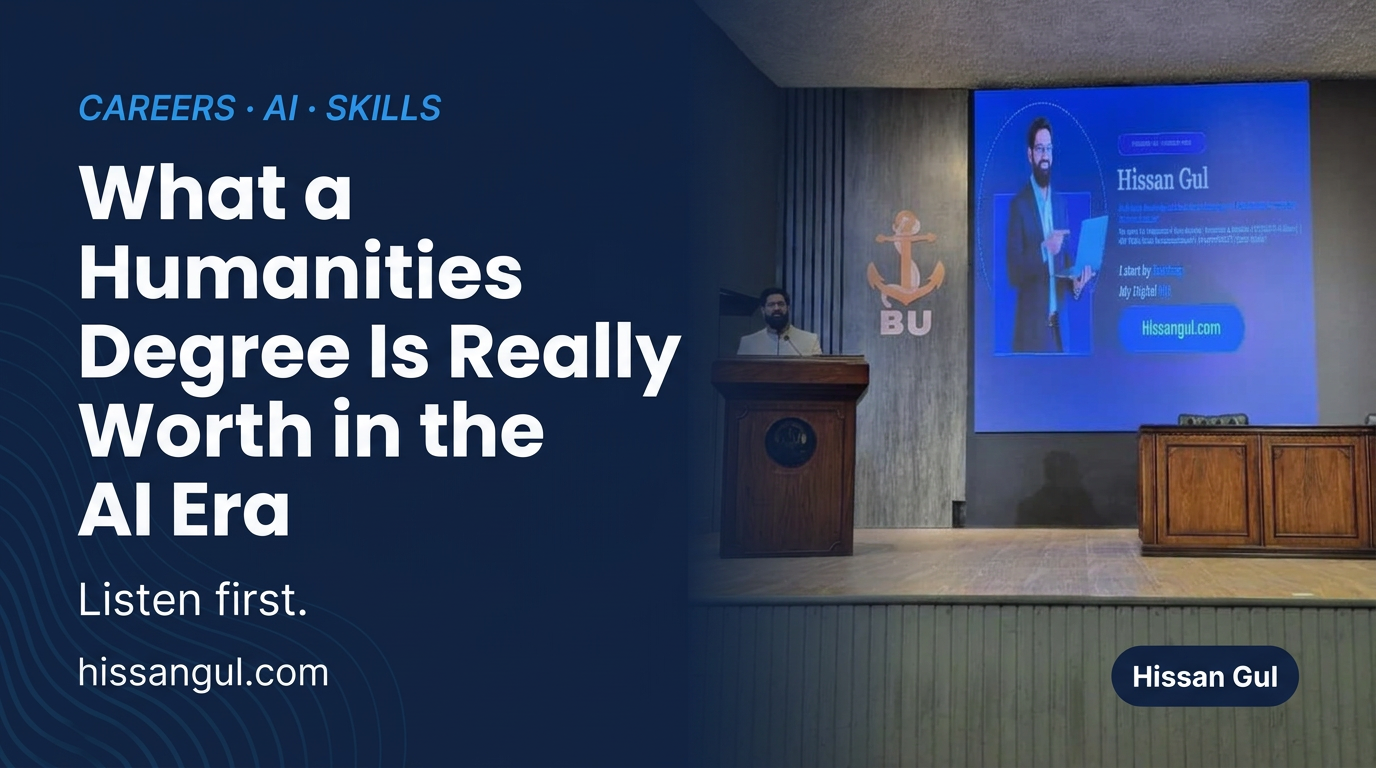
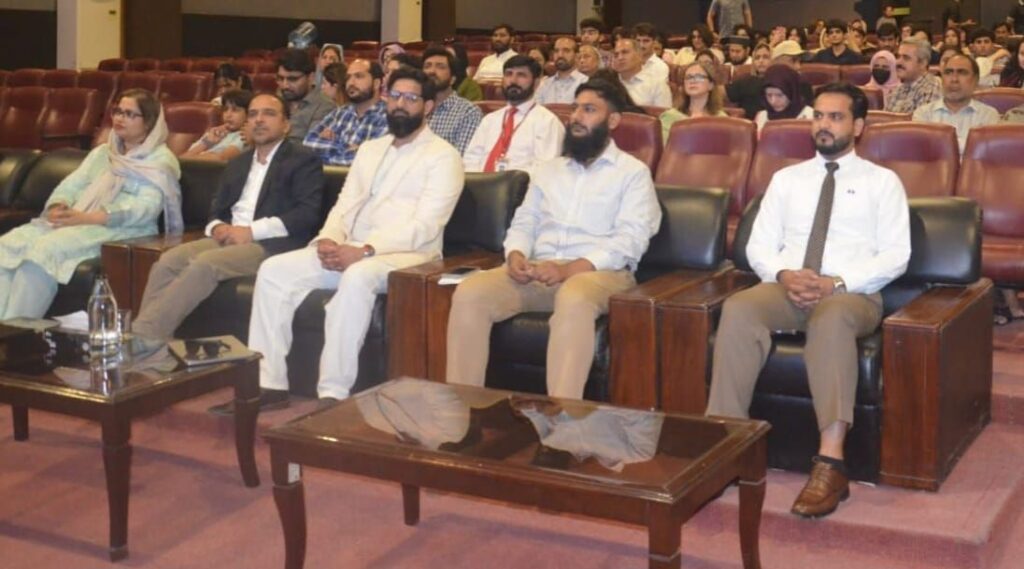
Is a humanities or social-science degree still worth the four years in the AI era? Yes — but only if you stop spending it blindly and start listening to the market first. That is the rule I went back to my old university to explain. The alumni office at Bahria University recently invited me to my old department, Humanities and Social Sciences, to talk to students about careers, emerging opportunities, and where AI fits. Standing at that podium, I could see myself in the front rows fifteen years ago. This is the argument I made in that room, written down — because it applies to far more people than one auditorium.
Key takeaways
- Listen before you spend. A degree is the biggest investment most students ever make — four years, real money, your best energy. Read what the market wants now and spend each year on purpose, instead of spending it all first and asking “what can I get?” at the end.
- The bottom of the career ladder is being rebuilt. The repetitive entry-level tasks that used to teach you are the exact tasks AI now does in seconds. In the United States, recent graduates now face higher unemployment than the overall workforce — a reversal of a pattern that held for decades (New York Fed data). The jobs didn’t vanish; they changed shape.
- The old skill describes; the new skill does something. Across every humanities field, value has moved from repeating knowledge to acting on it — reading the data, verifying the source, proving the message landed, judging whether the work is any good.
- Being good is not enough; you have to be found. If a search for your name returns nothing, then to the market, you do not exist. Publish your work where a stranger can read it.
- The market pays for specific — then for combinations. Go deep on one skill, then combine it across disciplines. A freelancer earns for hours worked; a founder owns something that earns while they sleep.
What did fifteen years actually teach me? Listen first
I sat where those students are sitting. Alongside the degree, I took extra classes that were not for credit — some marketing from the evening MBA, a little law. That small, deliberate mix shaped everything that followed. Strip fifteen years of work down to one line and it is this: before you spend money reaching people, you listen to them first. Read what they think and want. Then act.
I call it listening first — or, as a rule you can hold onto, Listen Before You Leap (LBYL): read what your audience wants before you spend time or money reaching them. It is the engine under everything I do, and it is the same lens I want students to turn on the degree itself.
Enrolling is that big investment — four years, real money, your best energy. Most students spend all of it first and only at the end ask, “So, what can I get?” That is spending before listening. Flip it. Listen first, keep reading what the market wants across all four years, and spend each one on purpose. And widen the question from “who will hire me?” to “what can I build?” Not everyone in that room is a future employee. Some are future founders.
Three things the market is telling humanities and social-science students right now — and one concrete move for each.
Why is the bottom of the career ladder disappearing?
Your first job used to be where you learned. You did the boring, repetitive work and you grew while doing it. That boring work is exactly what AI now does in seconds. This is not a prediction. In the United States, recent graduates have moved to higher unemployment than the workforce as a whole — a reversal of a pattern that held for decades, per New York Fed data. The force behind it, AI absorbing entry-level tasks, does not stop at any border. The entry rung didn’t disappear. The tasks that made it a learning rung did.
The jobs themselves did not vanish. They changed shape — and you can see the new shape inside your own subject.
- Media students: the market no longer needs someone who can write a press release. It needs someone who can read the audience data and tell the newsroom what to publish next.
- International Relations: it no longer needs someone who can only repeat theory. It needs someone who can read open, public information and explain what it really means.
- Development Studies: it no longer needs another project proposal. It needs someone who can prove the message reached the people it was written for.
- English: AI can produce a thousand words in a second. It cannot tell you whether they are any good. That judgement is yours, and it is worth more than ever.
See the pattern. The old skill describes. The new skill does something with the description. Your theory is not useless — it is your starting line, not your finish line.
The move: don’t fight AI, direct it. Learn these tools in your first year, not your final one. The graduate who can point AI at a problem and judge what comes back is doing the new job. The one who can only describe the problem is applying for the old one.
If nobody can find you, do you exist?
The direction of hiring has reversed. You used to look for the job; now, more and more, the job looks for you. A recruiter searches your name. Increasingly, they ask an AI system to surface people who do what you do. Here is the uncomfortable part: if that search returns nothing, then to the market, you do not exist.
Most graduates leave university as a blank page online. Four years of real work, and nothing a stranger can see. That is an invisibility you choose by default.
The move, and it costs nothing: start a blog and publish your assignments on it. The good ones. Alone, or with three friends. Right now your assignments earn a grade and then die in a drawer. Put them somewhere public and, in four years, they stop being old homework and become a portfolio — evidence a stranger can find, read, and hire from. Discoverability is not vanity. In an AI-mediated job market, it is existence.
What does the market really pay for?
The scale of the opportunity is not small. Pakistani freelancers earned a record 1.76 billion US dollars in export income in the last fiscal year, up 78 percent in a single year, according to State Bank of Pakistan data — driven overwhelmingly by young people with a laptop. But that money is not spread evenly. It flows to the ones who got specifically good at one thing.
So go deep on your one thing. Then combine it with someone else’s.
This is the advantage humanities and social-science students rarely use: the campus is full of other disciplines, and the best opportunities sit where fields that don’t usually meet are combined. Think about what it takes to build something real — say, a live tool that listens to thousands of people online and sorts what they say about a product into positive, negative, and neutral, city by city. Who builds that? Not one person and not one subject. It takes someone who understands people, someone who understands numbers, a designer, a coder, a business mind — and a law student to protect it. Many fields, one product.
You can do exactly this on campus, this year. Walk to the engineering department and find a student building a water filter for their final project who cannot explain it to anyone. Offer to tell its story. Take it to a software student for the app, a business student to price it, an environmental-sciences student to prove it works, and a law student to register it. Six students, six departments, one real thing — and it does not have to end as a grade. Register it. It is your property. You can build a company around it before you graduate.
A freelancer earns for the hours they work. A founder owns something that earns while they sleep. Pakistan already has the freelancers. The next wave is founders.
How should a Humanities student plan four years at a place like Bahria?
Here is the same argument as a plan you can actually follow, one year at a time.
- Year one — learn to direct the tools, and go public. Open the AI tools and use them on your coursework until directing them feels normal. Start the blog in month one, not final year. You are building two habits early: doing the new job, and being findable.
- Year two — get specific. Pick one skill inside your subject and go deep — good enough that the market would pay for it. Audience analysis, data storytelling, verification, research writing. Keep publishing. Depth is what the market pays for; “a bit of everything” is what it ignores.
- Year three — build one thing across departments. Find a real project in another faculty and attach your skill to it. Turn a semester assignment into something with your name on it and other people’s skills inside it.
- Year four — turn work into property and proof. Register what you built. Tidy the blog into a portfolio. Walk out with evidence, not just a transcript — so that when the market searches, it finds a person who has already done the work.
Play the four years like that and you do not leave hoping to be picked. The market comes looking for you — or you have already built the thing it needs.
What I’m building next: an interdisciplinary AI Master Class
That session convinced me of something I am now acting on. The single most valuable move a humanities student can make is not learning AI in isolation — it is building one real, cross-department project and owning it. Most students find that leap intimidating and never take it.
So I am putting together a Master Class built around exactly that: mixed student teams, one semester, one AI-integrated project taken from idea to something they can register and keep. It is workflow-first, not tool-first, and it is designed for students who find AI intimidating rather than the ones already showing off. I am building it with student-led societies, not over their heads. Details are coming soon. If you run a student body or a department and want your students in the first cohort, that door is open now.
Three things to start this week — not after graduation
It all comes back to one idea: listen first. Don’t spend four years and then ask what the market wanted. Read it now, and act now.
- Open the AI tools and learn to direct them — paired with your subject, so you are doing the new job.
- Start your blog and publish your work — so that when the market searches, you exist.
- Walk into another department, find one project, and build something you can own — property, not just a grade.
The humanities and social sciences were never the problem. Used this way — listening first, directing the tools, combining the disciplines — they are exactly the training the AI era is short of.
If this is you or your people, here is where to start:
- Students: publish one piece of your work this month, and watch for the Master Class.
- Universities and student societies: host the first interdisciplinary AI cohort with me — let’s build it together.
- NGOs and mission-driven teams: if you need audience analysis, ethical open-source research, or trust-led communication that you can prove worked, that is the work I do.
Start at hissangul.com.
Is a humanities or social-science degree still worth it in the AI era?
Yes — if you stop spending it blindly and start listening to the market first. Read what employers and clients want now, learn to direct AI, publish your work so you can be found, and get specifically good at one skill. The degree is your starting line, not your finish line.
What jobs can humanities and social-science graduates get in the AI era?
The valuable roles have shifted from repeating knowledge to acting on it: reading audience data and advising what to publish, verifying and interpreting open information, proving a message reached its audience, and judging the quality of AI output. The graduate who directs AI is doing the new job; the one who only describes the problem is applying for the old one.
How can a student become discoverable to employers online?
Publish your work where a stranger can read it. Start a simple blog and post your best assignments — alone or with friends. Over four years those posts become a portfolio that recruiters, and the AI systems they increasingly use, can find and hire from.
How much are Pakistani freelancers earning?
Pakistani freelancers earned a record 1.76 billion US dollars in export income in fiscal year 2025-26, up 78 percent year-on-year, according to State Bank of Pakistan data — with earnings spreading from software into design, marketing, content and other professional services. The money flows to people who got specifically good at one skill.
What is an interdisciplinary student project, and why does it matter?
It is one real product built by students from different departments — for example, a humanities student telling the story of an engineering student’s invention, priced by a business student, proven by a scientist, and registered by a law student. It matters because a founder owns something that earns for them, while a freelancer only earns for hours worked — and cross-department projects are how students start owning things before they graduate.
About the author. Hissan Gul is a Pakistan-based digital strategist, audience analyst, and strategic communications specialist with 15+ years across newsrooms, the development sector, e-commerce, and training, and previously Head of Digital at Independent Urdu. A Fellow of the International Center for Journalists (ICFJ) and a Google-certified Master Trainer for the Google News Initiative, he consults and trains on audience analysis, ethical open-source (OSINT) methodology, digital communication strategy, AI in journalism, and mobile journalism, with hands-on experience building workflow automation for newsrooms, PR teams, and not-for-profit organisations. He writes at hissangul.com.