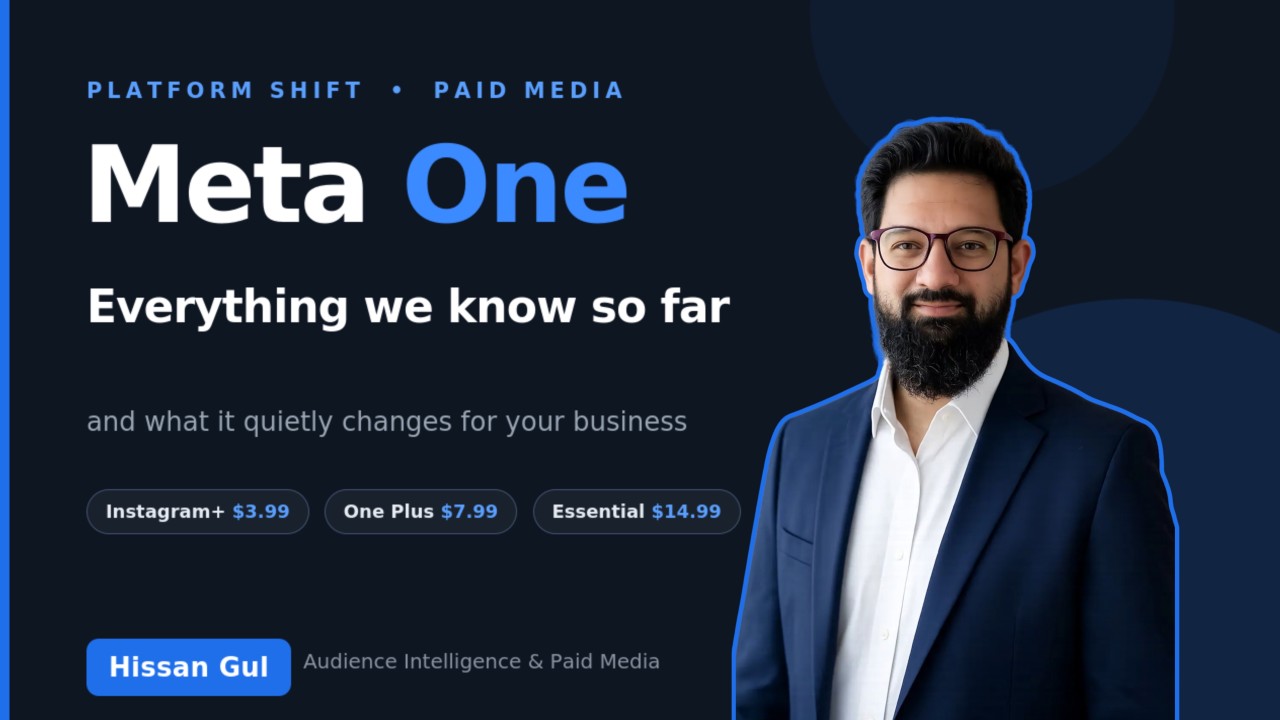
Meta just put its apps behind a paywall and started testing paid distribution for businesses. Here’s what’s real, what’s still a test, and what it means if you sell, serve, or campaign on Facebook and Instagram.
In 2014, Facebook opened Business Manager to advertisers outside the United States. I set one up almost immediately. I was among the first people in Pakistan running ads the professional way: a proper business account, with pages, ad accounts, audiences, and permissions in one place, owned by the business rather than tied to someone’s personal profile.
More than a decade later, I’m still having the same argument I had then.
Most businesses here still run their marketing by opening their page, finding a post that did alright, and pressing the blue “Boost Post” button. I’ve come to call it the blue button of death. It feels like advertising. It even spends money like advertising. But it skips everything that makes advertising work: the audience definition, the funnel, the pixel, the owned data, and the plan for what happens after the click.
I’m raising this now because Meta has announced something that makes the distinction matter far more than it used to. It’s called Meta One, and most of the businesses I work with have no idea it’s coming.
Here is what we actually know.
What Meta One is
Meta One is the new umbrella brand for everything you can pay Meta a monthly fee for. Based on Meta’s announcement and the early reporting around it, it pulls together three different kinds of subscriptions.
The first is already rolling out worldwide. These are the consumer “Plus” plans:
- WhatsApp Plus — $2.99/month: themes, custom ringtones, more pinned chats, premium stickers.
- Instagram Plus — $3.99/month: story insights, unlimited audience lists, posting without showing on followers’ feeds, custom icons and fonts, super reactions.
- Facebook Plus — $3.99/month: a similar set of expression and customization features.
These are mostly for power users and don’t change much for businesses on their own.
The second kind is for Meta AI, and is still in testing:
- Meta One Plus — $7.99/month
- Meta One Premium — $19.99/month: more compute, deeper reasoning, and more image and video generation.
The third kind is the one that should have every marketer paying attention. These are the creator and business plans, now being tested:
- Meta One Essential — $14.99/month: the Verified badge, impersonation protection, and an expanded link page for your profile.
- Meta One Advanced — $49.99/month: everything in Essential, plus being featured higher in the Facebook feed, ranking higher in Facebook and Instagram search, a bolder “Follow” button on Reels, automatic follow invitations to people who engage with you, shop and website links inside posts and Reels, deeper competitive and audience analytics, scheduling tools, the ability to share account access without sharing a password, and finally human support for your pages.
A few things worth noting. None of this replaces Meta Verified, at least for now. The AI plans are starting in Singapore, Guatemala, and Bolivia. The business plans are being tested first in Saudi Arabia, Morocco, Thailand, and Bangladesh, which tells you South Asia and emerging markets are squarely in Meta’s sights, not an afterthought.
Why Meta is doing this
Follow the money. Meta reported $56.3 billion in revenue in the first quarter of 2026, and almost all of it came from advertising. Everything else i.e. hardware, subscriptions, paid messaging, was small by comparison.
That is exactly why Meta One exists. When you have billions of users and nearly all your money comes from a single source, the obvious next move is to charge those users directly. Meta One is the billing counter for that strategy, built to grow over years rather than months.
For most businesses this looks like a menu of new features. I’d read it differently.
The shift hiding inside the announcement
Look closely at the Advanced plan. For $49.99 a month, a business can be featured higher in the feed, rank higher in search, and push a more prominent follow button. In plain terms: Meta is now selling distribution that used to be earned.
For fifteen years the deal was simple. You earned reach with good content, and you bought reach with ads. Meta One blurs that line. Now there’s a third lane: a subscription that quietly improves how far your organic presence travels.
This is good news and bad news, and which one depends entirely on how you operate.
If you run your presence professionally, you own your Business Manager, you hold your own audiences and pixel data, you know who your buyer is… these tools are an advantage. You can stack a small distribution edge on top of a system that already works.
If you run your presence by pressing Boost, Meta One just gave you a more expensive way to spend without a strategy. A $49.99 subscription will not fix a business that has never defined its audience. It will only move money faster.
That is the argument I’ve been making since 2014, with a new price tag attached.
What it means for each kind of organisation
- E-commerce. The shop and website links inside posts and Reels are genuinely useful, but only if you already have a pixel and a funnel behind them. Driving more traffic to a store that can’t track or retarget its visitors is the most expensive mistake in this space. Fix the foundation first; the subscription is the accelerator, not the engine.
- Government and public-sector bodies. Verification and impersonation protection matter more here than almost anywhere else, because trust and authenticity are the entire point of an official channel. Essential earns its cost on that basis alone. Paid distribution features deserve more caution, since public communication is judged by a different standard than commercial promotion.
- NGOs and INGOs. Tight budgets make the $49.99 plan a real decision rather than an easy yes. The honest answer is that better analytics and audience insight only help if you act on them. For a mission-driven organisation, the cheaper win is almost always sharper audience targeting and cleaner donor data, not paid placement. Treat Advanced as something you grow into, not something you start with.
- Influencers and creators. This is the group the Advanced plan was clearly built for. Auto-follow invitations, search ranking, content-reuse alerts, and a louder follow button all serve growth. The risk is the old one: buying reach to an audience you never took the time to understand. Relevance still beats volume, subscription or not.
- News media. Verification and impersonation protection are valuable in an environment where fake pages and misattributed content are a daily problem. The harder question is whether paying for feed placement sits comfortably with a newsroom’s credibility. That’s an editorial decision before it’s a marketing one.
- SMEs. Two features stand out. Human support, at last, for when your page breaks or your account gets locked — a problem that has quietly cost small businesses real revenue for years. And shared access without shared passwords, which is basic security hygiene that most small teams ignore. For many SMEs, those two alone may justify Essential.
- Entrepreneurs and founders. The temptation will be to subscribe your way to growth. Resist it. The founders who win with Meta One will be the ones who already own their accounts, understand their audience, and treat these features as multipliers on a working system, not a replacement for one.
The part that doesn’t change
Whatever you decide to pay for, the foundation is the same one it has always been. Own your Business Manager and your ad account. Hold your own audiences and your own data. Listen to your audience before you spend on reaching them. Treat paid tools, ads or subscriptions, as acceleration for something that already works, not life support for something that doesn’t.
Meta One rewards the prepared and punishes the rushed. It’s an advantage for businesses that built a system, and a faster drain for businesses that never did.
I started setting up Business Manager accounts in this country more than a decade ago because I believed the professional path would matter eventually. It matters now more than it ever has. I’m writing this to start the conversation early, and I’m already helping the businesses I work with get on the right side of it.
If you run marketing for an organisation, or you’re a founder weighing whether any of this is worth it, I’d like to hear how you’re reading it. The comments are open, and so is my inbox.
—
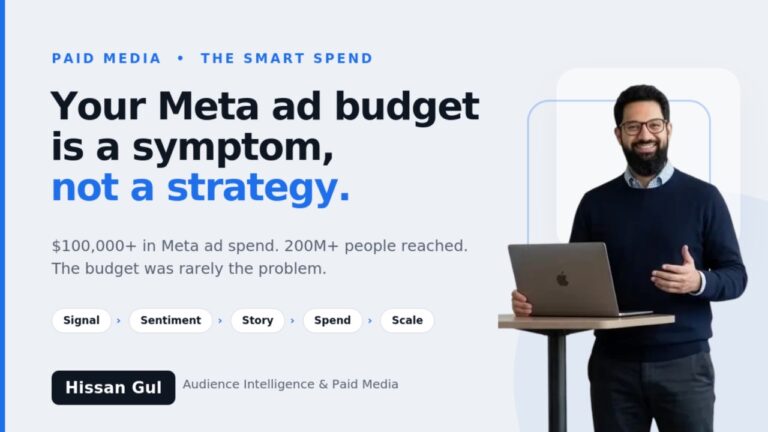
Hissan Gul has spent 13+ years in strategic communications and digital marketing, across newsrooms, hospitals, e-commerce, and the nonprofit sector. He has managed $100,000+ in Meta ad spend reaching 200M+ users, led digital and video for Independent Urdu, and trains teams on audience intelligence and open-source research. He currently works in strategic digital communication at the U.S. Embassy in Islamabad and writes here in a personal capacity, drawing on his independent consulting and agency work.
Plan names, prices, and test markets are based on Meta’s announcement and early reporting as of late May 2026, and may change as Meta One expands.