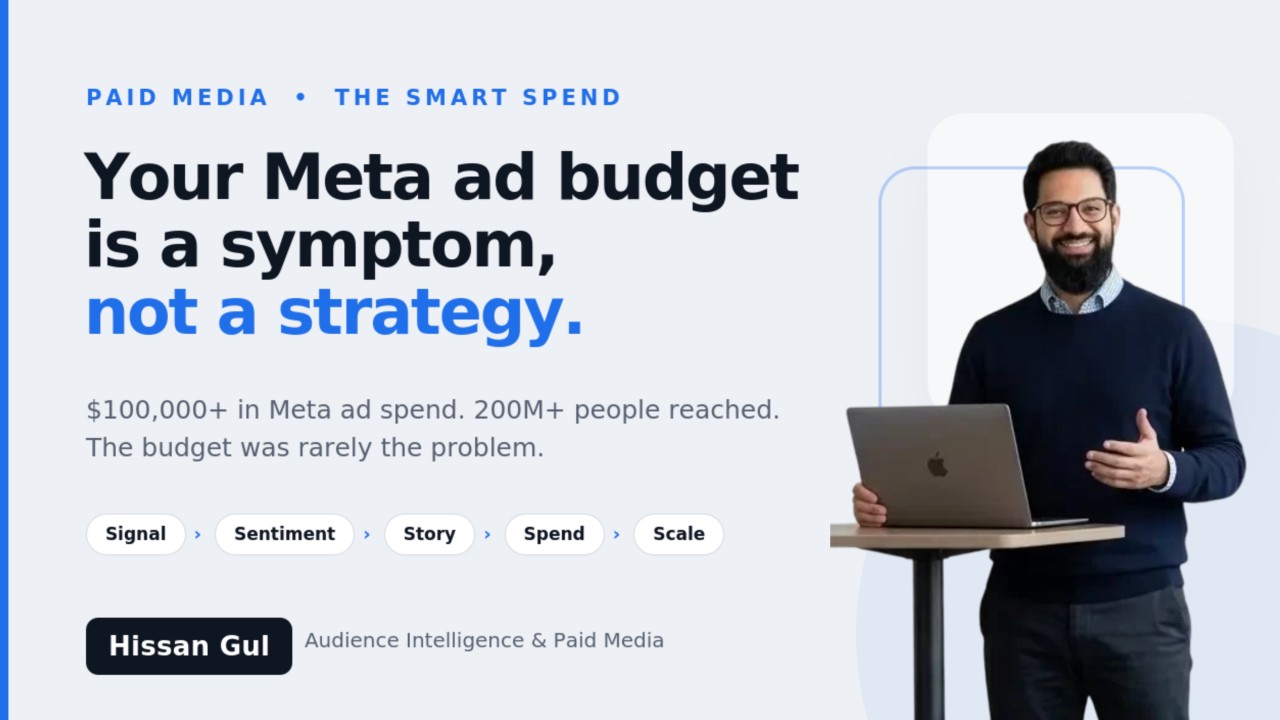
After managing more than $100,000 in Meta ad spend across hospitals, e-commerce, restaurants, tourism, real estate, and nonprofits, I can tell you the campaigns that struggled almost never struggled because of money.
Most ad conversations start in the wrong place. The first question is usually “how much should we spend?” or “which creative won?” Reasonable questions. Just not the first ones.
The first question is simpler, and harder: do you actually know who you’re talking to? Most advertisers, including senior ones who have run accounts for years, can’t answer that with anything sharper than an age band and a city.
I’ve spent the better part of a decade running Meta campaigns for hospitals, e-commerce platforms, nonprofits, and a few personal brands. More than $100,000 in spend, reaching over 200 million people. The campaigns that underperformed almost never failed at the budget line. They failed in the setup, before the first rupee moved.
Here is the pattern I keep seeing, and one campaign where doing the opposite changed the arithmetic entirely.
The quiet drains that inflate every campaign
The audience is an afterthought. Targeting gets decided in the last ten minutes of setup, usually as a wide net “to be safe.” A wide net is the most expensive net there is.
- There is no funnel, because there is no journey. Rarely is there a map of how a stranger becomes a buyer, and what each stage needs to hear. One message gets pushed at everyone, so the person who almost bought yesterday gets the same line as the person who has never heard the name.
- An allergy to a small website and a pixel. I’ve watched founders refuse a modest spend on a simple site, then quietly overpay on ads for a year. Without a site and a pixel, you are asking the platform to optimise blind. It can only learn from what it can see, and a “message us” button tells it far less than real behaviour on a page you own.
- No detailed targeting. Interests, behaviours, and the layering that separates “people in this city” from “people in this city who likely need what you sell” get left on the table.
- The one-campaign expectation. People want a single campaign to deliver the whole result, like a slot machine. Paid media is a system that compounds, not a coin you drop once.
- The audience is never captured or kept. Everyone who clicked, watched, or messaged just told you something valuable. That signal is exactly what builds a lookalike audience and makes the next campaign cheaper. Most advertisers let it evaporate, then start the next round cold.
- Outsourcing that quietly hands away the asset. This is the one that costs the most over time. An agency or freelancer runs everything inside their own Business Manager and ad account. When the relationship ends, the client walks away with nothing: no spend history, no pixel data, no audiences. The fix is unglamorous and not optional. You own the Business Manager and the ad account. You add the marketer with permission to run ads. The history and the audiences stay yours.
- Influencers as a reflex. Budget goes to creators because that is what everyone does, often without checking whether their followers resemble the actual buyer at all.
- Picking creators by the wrong number. Follower count and a quick glance at the likes get the credit. Whether the audience is relevant, and whether the engagement means anything for the product, gets ignored. A creator with 30,000 of the right people will beat one with 300,000 of the wrong ones, every time.
None of these are exotic. That is the point. They are ordinary, and they are expensive.
Listen before you launch
The thread running through every one of those mistakes is the same: spending before listening.
The work I trust runs the other way around. I think of it as a sequence: Signal, then Sentiment, then Story, then Spend, then Scale. You read what your audience already says and does. You map how they feel and where. You shape the message around that reality. Only then do you spend, and you spend efficiently, because the first three steps did the hard work. Scale is what you earn once the system holds.
Before any budget moves, I run one discipline I never skip. I call it Listen Before You Launch. You establish who the audience really is, what they are already telling you, and what signal this campaign will capture so the next one starts smarter than this one did.
One campaign in Islamabad
In 2021 I took on a private hospital in Islamabad.
In the first meeting they wanted the conventional route: run one campaign, wait for patients. I told them plainly it would not work, and I explained why at length. To their credit, they listened.
Instead of starting with ads, I started with their own data. I asked for a few specific sets: where their existing patients lived, the minimum and maximum they spent on services, and how many of them also bought from the in-house pharmacy. That told me who their real patient looked like. Not a demographic guess, a profile built from people who had already paid.
From that I built a tightly defined audience and pointed the campaign at a single action: send us a message. But I did not leave the inbox to chance. I set up a short, guided conversation in Roman Urdu, the way people there actually type, that answered the common questions and, at the end, asked for a phone number so the front desk could call back. That number did double duty. It let staff follow up while intent was still high, and it let us rebuild the audience from real contacts for the next campaign.
The results held. One campaign brought in 47 patients, at an estimated average service spend of around PKR 19,000, close to PKR 0.9 million in attributable revenue from a single push. The inbound was heavy enough that following up properly needed two dedicated callers.
The lesson was not the creative, and it was not the budget. It was that we listened first, captured what we learned, and built the inbox journey instead of hoping for one.
A short pre-launch checklist
Before your next campaign, I would ask:
- Can you describe your buyer from your own data, not a demographic guess?
- Have you mapped the journey from stranger to customer, with a different message for each stage?
- Is a pixel live on a site you own?
- Do you own the Business Manager and ad account, with the marketer added rather than in control?
- What audience will this campaign leave behind for the next one?
- If you are using a creator, does their audience match your buyer, or just look big?
If three of those answers are shaky, the budget is not your problem yet.
Where this leaves you
I’ve made versions of most of these mistakes myself, early on, with my own money. That is where the conviction comes from.
If you run accounts at a senior level, or you are a founder spending your own budget, I would like to know where your experience matches this and where it does not. The comments are open, and so is my inbox. The most expensive word in this work is still “guess.” Most of what I do is help people replace it.
—
Hissan Gul has spent 13+ years in strategic communications and digital marketing, across newsrooms, hospitals, e-commerce, and the nonprofit sector. He has managed $100,000+ in Meta ad spend reaching 200M+ users, led digital and video for Independent Urdu, and trains teams on audience intelligence and open-source research. He currently works in strategic digital communication at the U.S. Embassy in Islamabad and writes here in a personal capacity, drawing on his independent consulting and agency work.