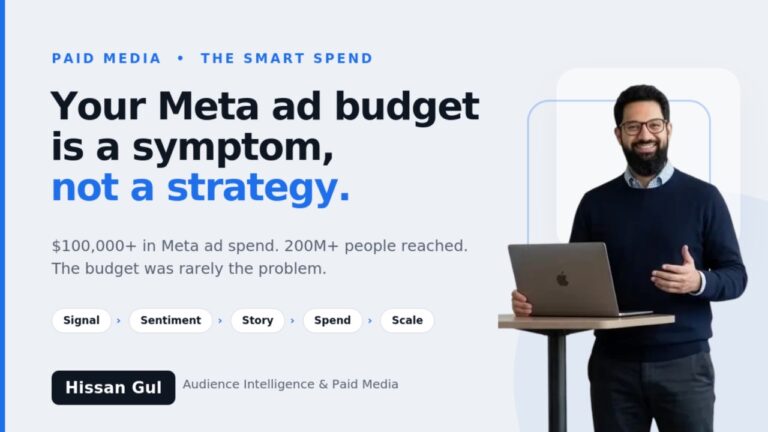
A few years ago, running an ad meant choosing your audience by hand: age, location, interests, behaviour. The big platforms have largely taken that job away. Meta’s Advantage+ and Google’s Performance Max now ask for a budget, some creative, and a goal — then decide for themselves who sees the ad. The pitch is seductive: the machine knows your audience better than you do.
Sometimes it does. But here’s what gets missed. These systems are only as good as the signals you feed them. They learn from your past conversions, your own customer data, and whatever public behaviour they can still observe. As privacy rules tighten and tracking cookies fade out, those signals are thinner than they used to be. Feed a smart system weak inputs and it does exactly what you’d expect — it guesses, confidently, and spends your money while it learns.
The result is a quiet kind of waste. The dashboard looks busy. Reach is high. Yet reaching everyone and persuading the right someone are not the same thing — and the gap between them is where budgets disappear.
This matters more in markets where the audience isn’t where you assume it is. Pakistan has around 80 million social media identities, but the make-up is lopsided: Facebook’s advertising audience in the country skews close to 80% male. A brand selling to women that hands its budget to an automated system, without strong first-party signals to steer it, will watch the algorithm optimise toward the cheapest available attention — which on that platform is overwhelmingly male. Meanwhile TikTok has surged to become one of the largest platforms in the country, which means the audience a brand assumed was on Facebook may simply have moved.
The fix is not to abandon automation. It’s powerful, and it isn’t going away. The fix is to stop treating it as a substitute for understanding your audience. Three practical moves:
• Feed it real signal. Give the system strong first-party data, and where you can, audience intelligence drawn from what people actually say and do in public — not from assumptions made in a meeting.
• Lead with message, not just budget. The algorithm decides who. You still decide what. A message built from genuine audience understanding outperforms a generic one no matter how sharp the targeting.
• Measure the real outcome. Track cost per genuine result — a lead, a sale, a sign-up — not reach or impressions. Reach is the easiest number to inflate and the least useful.
The organisations getting value from these tools in 2026 aren’t the ones who automated the most. They’re the ones who understood their audience first, then let the machine act on that understanding.
If you’re spending on Meta or Google and you’re not certain what signals you’re actually feeding the system — or whether it’s reaching the people who matter — that’s the gap worth closing before the next rupee goes out. It usually starts with a single, unglamorous question: who are we really trying to reach, and what do we actually know about them?
About the author. Hissan Gul is a Pakistan-based digital strategist, audience analyst, and strategic communications expert with 15+ years across newsrooms, the development sector, e-commerce, and training. A Google-certified trainer and an International Center for Journalists (ICFJ) fellow and master trainer, he consults and trains on audience analysis, ethical OSINT methodology, digital communication strategy, AI in journalism, and mobile journalism — with hands-on experience building workflow automation for newsrooms, public relations teams, and not-for-profit organisations. He writes at hissangul.com.